
US Dollar Slips Again as Debasement Fears Override Bessent’s Support
The US dollar slipped again as renewed debasement fears pushed investors toward gold and other tangible safe havens, overshadowing Treasury Secretary Scott Bessent’s support for a strong-dollar policy.
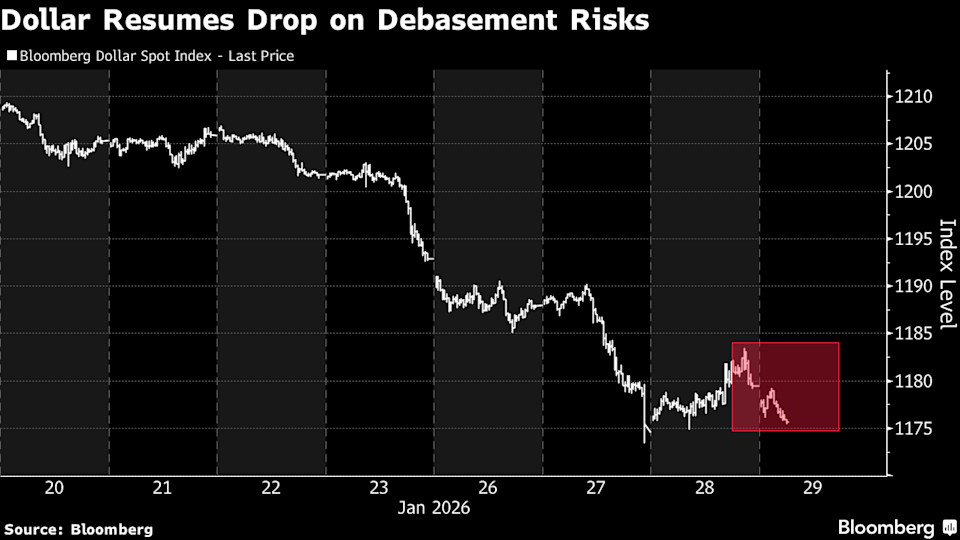
The US dollar weakened again, giving up Wednesday’s brief rebound, as renewed debasement fears outweighed Treasury Secretary Scott Bessent’s reassurances on a strong-dollar policy.
Bloomberg’s dollar index slipped 0.3%, while precious metals such as gold and silver extended their record-breaking rallies. The greenback has struggled to act as a safe haven, with investors increasingly favoring tangible assets, according to DoubleLine Capital CEO Jeffrey Gundlach.
Bessent attempted to shore up the currency on Wednesday, saying the US “always has a strong dollar policy,” after President Donald Trump triggered a selloff a day earlier by signaling comfort with a weaker dollar to support US businesses.
Market participants said Bessent’s remarks reflected a degree of strategic ambiguity. Damien Loh, chief investment officer at Ericsenz Capital, noted that an explicit weak-dollar stance could spiral out of control, suggesting policymakers instead favor a gradual depreciation.
Bloomberg strategists said the dollar’s recovery proved short-lived, underscoring how difficult it will be to restore investor confidence amid erratic trade and economic policies and mounting concerns over the US debt burden.
The dollar’s decline over the past year has become known as the debasement trade — a wager on a long-term erosion of the currency’s purchasing power driven by unpredictable policymaking, large deficits and growing US isolation. Bloomberg’s dollar index is down more than 2% this year, following an 8.1% drop in 2025.
Among major currencies, the Australian dollar led gains against the greenback, rising 0.6% and heading for its longest daily winning streak in more than a decade. The New Zealand dollar climbed 0.5%, while the Swiss franc advanced 0.3%.
Sentiment toward commodities and commodity-linked currencies was further supported by reports that Chinese property developers had stopped submitting regular disclosures on the so-called “three red lines” as early as 2023, signaling a softening of strict leverage rules that deepened the real estate downturn.